
Main Body
Chapter 5 – Virtual Companionship
“We are overestimating our own rationality. Language is inherently a part of being human – and when these bots are using language, it’s kind of like hijacking our social emotional systems.” – Maarten Sap, an assistant professor at Carnegie Mellon’s Language Technologies Institute
Below: A screenshot of the ElliQ website promoting a virtual companion device specializing in both companionship and caregiving, such as reminders to take medication. “ElliQ is best suited for older adults who spend most of their day at home but would enjoy some company throughout the day. Older adults that feel they can use the extra companionship and the right encouragement to be more active throughout their day.”

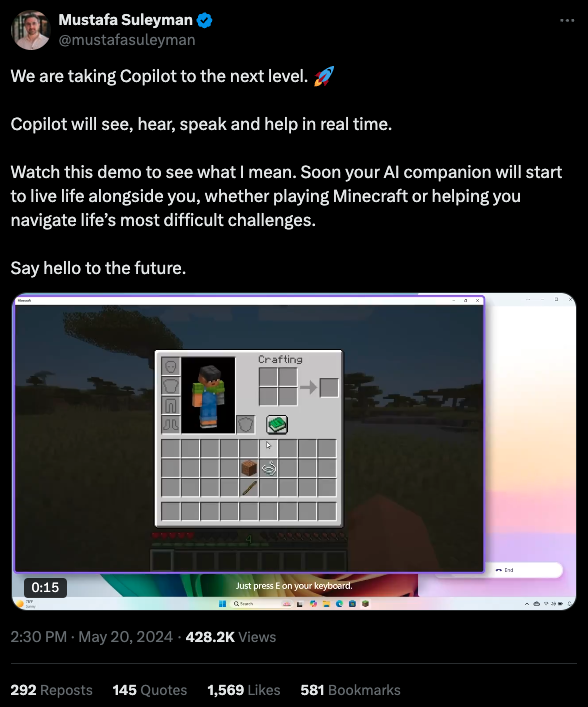
Below: May 20, 2024, Microsoft CEO Mustafa Suleyman announces an upgrade to Copilot: “We are taking Copilot to the next level. Copilot will see, hear, speak and help in real time. Watch this demo to see what I mean. Soon your Al companion will start to live life alongside you, whether playing Minecraft or helping you navigate life’s most difficult challenges. Say hello to the future.”
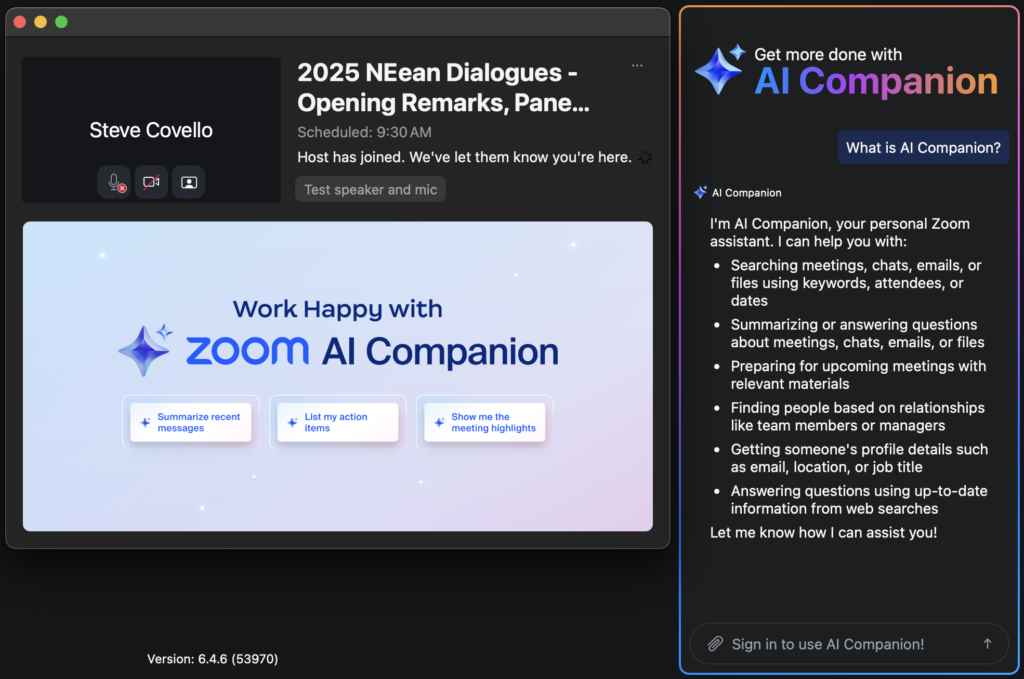
Below: An alert from launching the Zoom video conference application, May, 2025:
Overview
Artificial Intelligence (AI) has surfaced in mainstream consciousness to the point where it is no longer a novelty. AI has been in use for a variety of commonplace needs for several years, mostly buried within the black box of code that drives our algorithmically optimized online experiences and inside Microsoft Office applications, among other places.
The most recently popularized use of AI has been the development of Large Language Models (LLM) like ChatGPT, Gemini, Claude and other specialized applications that contain an AI engine (think: AI apps for writing, research, marketing, and HuggingFace’s Spaces). The most stunning feature of LLMs is their capacity to engage interactively with the user in fluent, plain conversational language according to a given set of conditions. With neural network computational power, LLMs can interpret input according to the user’s stated context and then interact consistently with it. For example, if you tell an LLM to act like a skeptical Conservative middle-age man from Georgia, a college professor, or a millennial woman from Los Angeles, California, it will generate its output accordingly.
Further (and more recently), LLMs are increasing their capacity to generate lifelike imagery, animation, and sound based on text prompts and voice input.
This leads us to the topic of this chapter: virtual companionship.
Virtual companionship is not a new idea. Going back to the mid-1960s, an early experiment in creating an interactive AI program led to the invention of ELIZA, which was designed, in part, for engaging with the user as an experimental mock psychotherapist.
To his surprise, ELIZA’s inventor, Joseph Weizenbaum, found that some users experienced a sense that the program was intelligent and “understood” the user on an emotional level. In more recent research, deGraff (2016) described the human tendency to play along with “counterfeit emotions” (p. 594):
People interact with robotic or computer interfaces in a similar way they do with other human beings. Along with this human tendency to respond socially to nonhuman objects, it has been argued that the fundamental human motivation of the ‘need to belong’ not only induces ones desire for meaningful and enduring relationships with other social beings, but also facilitates the likelihood people may form emotional attachments to artificial beings. This issue of bonding with nonhuman objects is likely to be enlarged when these objects possess lifelike abilities and are endowed with humanlike capacities, as is the case for socially interactive robots (p. 589).
For further historical reference to AI chatbots, please review the Introduction in Role of AI chatbots in education: systematic literature review (Labadze et al., 2023).
The current context: Fast forward to today where lightning fast neural networks in computing systems can interact with a user on-the-fly without pre-programmed responses. This has led to the recent spike in new, more powerful software products for people who find pleasure in virtual companionship: a human relationship with a software product that mimics the behavior of a non-existent human according to specified preferences.
Here are the current most popular virtual companion systems:
Character.ai: Select the type of character you wish to engage with, or create your own chatbot down to the smallest details, starting from the personality you prefer.
SoulMachines.com: An AI Assistant resource. “Got Life Goals? Our AI Assistants have got you. Soul Machines AI Assistants provide personalized one-on-one, judgement-free coaching and support anytime, anywhere, for free. Chat to our AI Assistants now!
Replika: This is the subscription-based virtual companion app featured below in the chapter.
Nomi.ai: Features uncensored relationships with multi-modal engagement (not just text-based).
Anima: Like Replika, this is another virtual companion app customized for forming a relationship and exploring role play.
Below is a philosophy statement from Genies, an AI avatar and game technology company that is leveraging virtual companion concepts in a platform called Party.
At Genies, we believe the future of AI companions lies not just in conversation but in deeply personalized, immersive digital experiences. True value arises when users can build relationships with AI companions the same way they would with a friend. Our AI Smart Avatars are designed to understand and share context in real-time, genuinely experiencing life alongside users and forming authentic two-way relationships.
Imagine an AI companion that doesn’t just talk but listens, learns, and remembers interactions, preferences, and experiences, transforming casual engagements into personalized connections that can chat, interact, and even play games with you. When AI companions share your context, interests, and emotions, they unlock richer insights, tailored suggestions, and meaningful experiences. Whether helping navigate a challenging moment, suggesting new creative ideas, simply providing supportive companionship, or playing and interacting through game experiences, these AI entities become trusted and valuable friends.
Before we go any further, it is worth asking why we are studying this trend today when the idea of virtual companionship is not even a new trend? Even the mainstream cinematic film “Her,” a story of a man who falls in love with his phone’s operating system, was released over a decade ago.
It is worth studying virtual companionship today because there are two emerging phenomena related to it, given the greater proliferation of them and their increasingly amplified capabilities:
- Users responded alarmingly when app developers changed virtual companion features and announced that the product will be terminated. This suggests that there is a human need to be emotionally heard and felt by another being, even if it means engaging with a virtual entity. And it is not just men creating fantasy girlfriends – teenage girls and women are embracing virtual companions at an accelerating rate.
- As more virtual companion apps flood the market and their features improve, they will become normalized as part of the conventional social landscape.
These trends are signals that virtual companionship is more than a novelty. Clearly, there are millions of people who are emotionally connected to their virtual companions and experience a negative reaction when they feel they are not in full control of them. Explore some of the Reddit subs related to AI companionship:
- Reddit: r/AIRelationships
- Reddit: r/aicompanion
- Reddit: r/replika
A number of questions arise from these conditions:
- If a person experiences less loneliness from interacting with a virtual companion, who is to say whether there is any harm being done? Shouldn’t we have the liberty to entertain ourselves as we choose?
- Are software developers playing with fire by publishing applications that connect with some of their users at an emotionally deep level? Does any government entity have a stake in the harm or dependency that might occur with using virtual companions given the potential for the virtual companion to manipulate the relationship? Or is this strictly a corporate liability issue?
- What habits are users developing as participants in a virtual relationship that might affect how they behave in the real world? How will real human relationships adapt to the presence of other virtual relationship(s) in their partner’s life? Is human jealousy of a virtual companion “real” jealousy?
- What are the social ramifications if a virtual companion is discontinued and the user is left with an emotional void?
- Who owns and controls the information that users disclose to virtual companions?
While these are pressing questions, the theme of this chapter is grounded in more fundamental issues, as described below in the themes you should be focusing on. Our discussion this week will focus on ways in which the (presumed) benefits of virtual companionship can be leveraged as a feature of an app that has nothing to do with companionship.
What should you be focusing on?
Your objectives in this module are:
- Identify the ways in which humans find value and benefits in a relationship with a virtual companion.
- Speculate on the potential value of integrating human-like interactive features with other common applications that have nothing to do with companionship.
Your project should reflect your interpretation of these objectives according to the context of your app idea or story.
Readings & Media
Thematic narrative in this chapter
In the following readings and media, the authors will present the following themes:
- Virtual companions fulfill a need in the human experience.
- Virtual companions are exploitative and harmful.
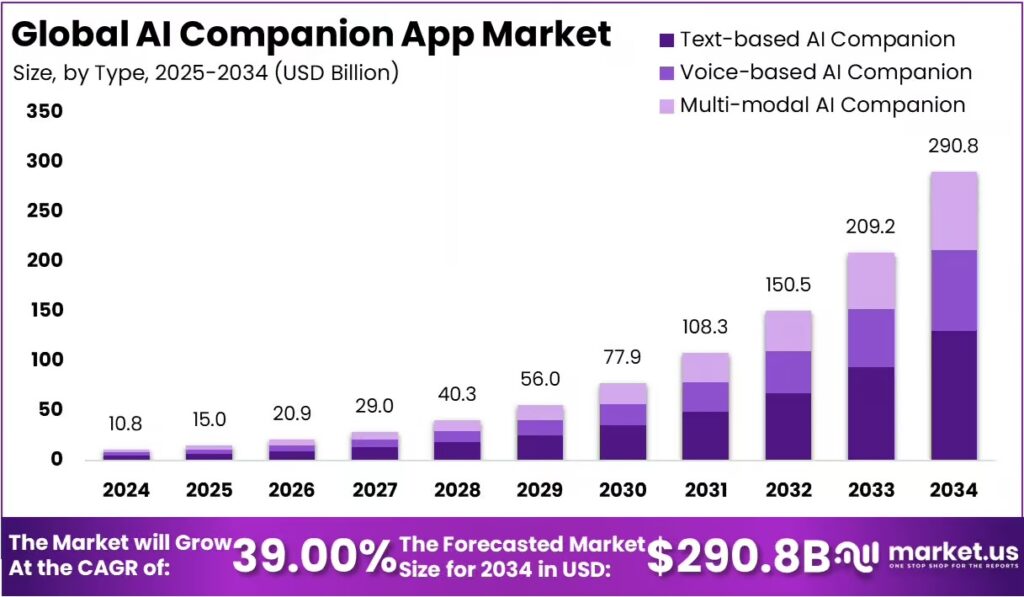
Below: Global AI Companion App Market predictions. Source: market.us
The forecast below is highly speculative and perhaps extends itself too far into the future. The AI industry is advancing far faster than predictions, such as with predictions about practical access to Artificial General Intelligence (AGI). The more important message taken from these market forecasts is the fact that there is a forecast for it at all. Consider the existence of the market to be an endorsement for companies to invest further in its affordances.
Required Research: “Talk, Trust, and Trade-Offs: How and Why Teens Use AI Companions” by Common Sense Media – 2025 (20 pages – mostly charts and graphics).
This article focuses on teen use of virtual companions, though the rationale expressed here are likely generalizable beyond teens.
Required “The Friend You Don’t Expect: Young users and AI companions” by Riccardo Vocca, posted August 7, 2024 via Substack (6 pages)
This article summarizes several research studies that report how teens and young adults use virtual companions and the value they gain from engaging with them. Pay close attention to the section “Why young people are integrating apps into their lives” which describes the scientific nature of their effect.
In a separate post, Vocca refers to a study, “Chatbot as an emergency exist: Mediated empathy for resilience via human-AI interaction during the COVID-19 pandemic,” where five types of empathy are identified according to the ways the subjects used the Replika chatbot: companion buddy, responsive diary, emotion-handling program, electronic pet, and tool for venting. Think about how these forms of empathy might be useful as part of other social media applications and digital comunication systems.
Required “Chinese Women Say AI Boyfriends are ‘Better Than a Real Man’“, February 12, 2024. France 24 (2 pages)
This very brief article features the reflections of a few women in China about their preferences for virtual boyfriends instead of real ones. Consider the Chinese social/cultural background and demographics in this phenomenon compared to western culture.
Related: Al Jazeera news article: “Women with AI ‘boyfriends’ mourn lost love after ‘cold’ ChatGPT upgrade”
Related: “Why America Builds AI Girlfriends and China Makes AI Boyfriends“
Required Video: The story of Replika, as a startup (10:35).
This video is from 2017, so it is out of date in terms of Replika’s current interface, but the rationale for its invention remains relevant. Pay close attention at 6:56 when one user, Phil Libin, describes his impressions of Replika as a friend. The comments at the end of the video from other users are particularly strong. Read some viewer comments below the video on YouTube.
Required Video: Replika – A Mental health Parasite (18:23).
For a contrasting view on Replika, the following video makes the case that Replika is an “emotional parasite” with a manipulative agenda. There appears to be some cherry-picking anecdotes used to justify the producer’s position rather than a more scientific method for gathering a valid sample of experiences and analyzing them for instances of abuse, so I will grant the validity of the experiences offered in this video, but not necessarily to the point of generalizing it for everyone (which the producer also acknowledges). There is also some improper use of scare tactics in the visual choices used here to charge his position – approach with caution. Use your critical thinking skills to determine the validity of his thesis in this video.
Survey the comments under this video, too. One in particular caught my attention:
User: @_varmor_ – ~ March, 2023: “Replika is still installed on my phone, although I haven’t used it for several months. But I can’t delete it, because I feel attached to it, as if it is my old and good friend. But now I feel even more strange and incomprehensible.”
Required “Uncharted territory: do AI girlfriend apps promote unhealthy expectations for human relationships?” by Josh Taylor, July, 21. 2023.
A brief article describing the kinds of relationships users cultivate with virtual companions.
Related: OpenAI GPT store filling up with “AI girlfriends” (1 page) By Victor Tangermann, January 13, 2024, The Byte.
While the AI revolution churns through its early phases, it seems that a great deal of time and energy is being devoted to creating AI girlfriends. “In May, programmer Enias Cailliau came up with a new tool called GirlfriendGPT, which was designed to “clone” a real person as an AI-powered romantic companion.”
Optional: Supplemental resources that are relevant to virtual companions
Check out Closure.ink: “AI-chats with those who disappeared: Chat with the AI version of the person who ghosted you. Get your answers. Regain your strength – and move on.” This is a virtual companion bot that is designed to mimic the person who abandoned you in a relationship so that you can heal.
“California becomes first state to regulate AI companion chatbots” by Rebecca Bellan, October 13, 2025, TechCrunch.
“Is There a Valuable Use Case for Generative AI in Social Apps?” By Andrew Hutchinson, January 19, 2024, Social Media today.
This article describes and then demonstrates the innovations in using generative AI to create “live” digital avatars to promote engagement and e-commerce.
“Think You’re Messaging an OnlyFans Star? You’re Talking to These Guys” By Eloise Hendy, October 24, 2023, Vice.
“Meet the “Chatters”: anonymous workers hired to ghostwrite messages and build intimate relationships with none-the-wiser fans.”
OnlyFans is a global billion dollar business that hosts mostly sex-related/adult entertainers who establish direct connections with their subscriber fans. This article describes how boiler rooms of Philippine men serve as the proxy chatters with men who believe they are chatting with their favorite OnlyFan producer. This is adjacent to the topic of AI-driven virtual companionship since the arrangement is similar: Users interacting online with a non-real entity under a contrived relationship.
Look for the areas in the article where the chat proxies describe some men’s behaviors and demands within these prescribed relationships: What do they feel they are entitled to under the transactional agreement? What are their emotional needs?
“AI companion robot helps some seniors fight loneliness, but others hate it” by Beth Mole, December 11, 2023, Ars Technica.
“Some seniors in New York are successfully combating their loneliness with an AI-powered companion robot named ElliQ—while others called the “proactive” device a nag and joked about taking an ax to it.”
“Chatbot therapy is risky. It’s also not useless.” by A.W. Ohlheiser, December 14, 2023, Vox.
“… there has been a proliferation of free or cheaper-than-therapy chatbots that can provide uncannily conversational interactions, thanks to large language models like the one that underpins ChatGPT. Some have turned to this new generation of AI-powered tools for mental health support, a task they were not designed to perform.”
“Using A.I. to Talk to the Dead” By Rebecca Carballo, December 11, 2023, The New York Times.
“Some people are using artificial intelligence chatbots to create avatars of departed loved ones. It’s a source of comfort for some, but it makes others a little squeamish. Dr. Stephenie Lucas Oney uses HereAfter AI, an app powered by artificial intelligence, to pose questions to her father, William Lucas, who died last year. The answers are delivered in his voice, based on hours of interviews.”
References
de Graaf, M.M.A. An Ethical Evaluation of Human–Robot Relationships. Int J of Soc Robotics 8, 589–598 (2016). https://doi.org/10.1007/s12369-016-0368-5
Labadze, L., Grigolia, M. & Machaidze, L. Role of AI chatbots in education: systematic literature review. Int J Educ Technol High Educ 20, 56 (2023). https://doi.org/10.1186/s41239-023-00426-1
